Visiting Calanais
An extract from Awakenings - Why Neopaganism and the Folk Renaissance Matter
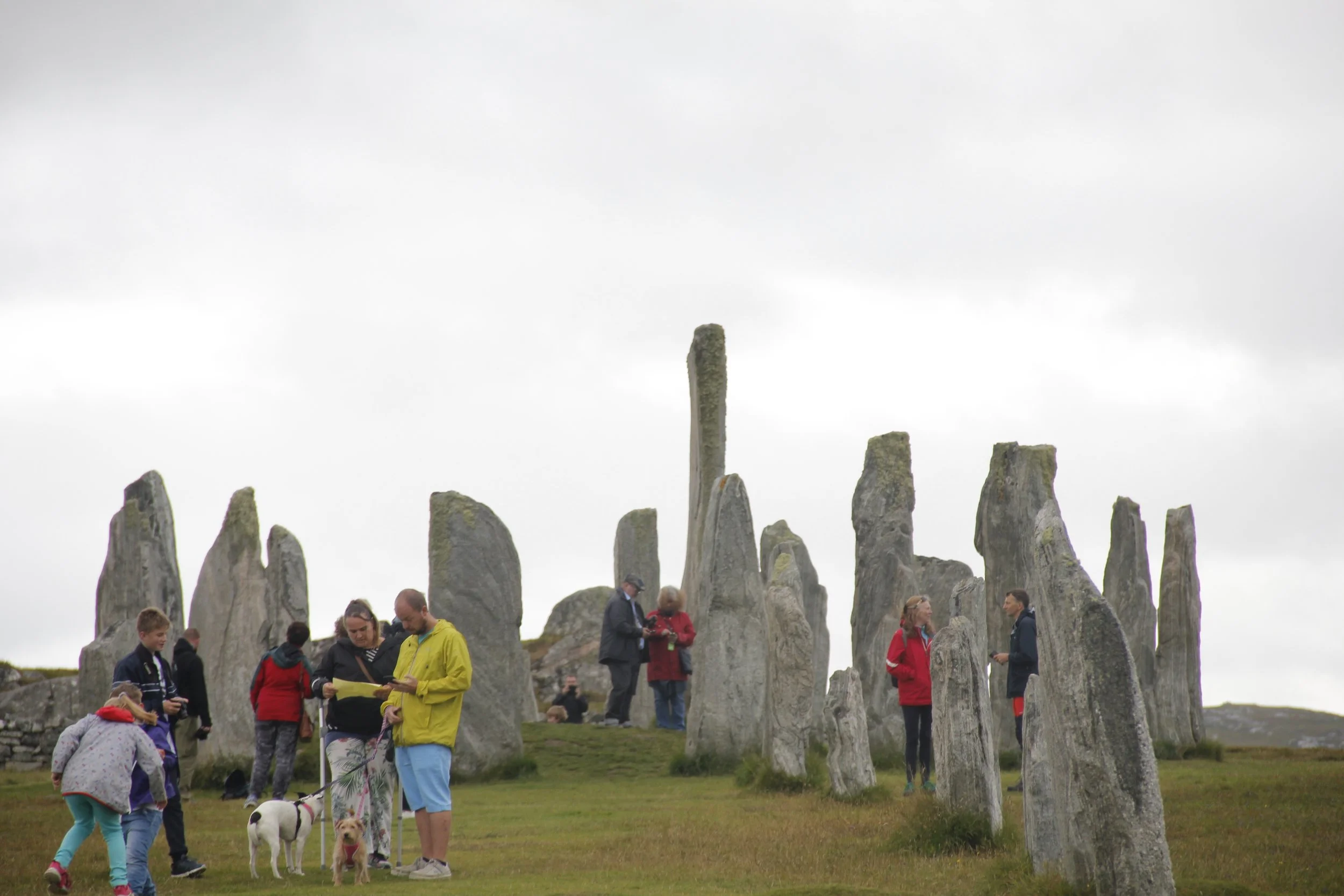
Calanais, or Callanish if you prefer
The first time I visited the Outer Hebrides was in 2006 and it was a memorable trip.
I was a police officer back then but seconded to the Home Office. I was also working with the Scottish Parliament on a project that required me to visit several places around the country to talk to local councils and policing teams. And so it was that on Sunday November 5th (there’s a good reason why I remember the date so clearly) I caught a plane from London Gatwick to Glasgow Airport and then transferred onto a smaller, propeller-driven plane for the flight to Stornaway on the Isle of Lewis. There were only four other passengers, which maybe explains why the security officers at the gate were so zealous. They subjected me to a more thorough search than I’ve ever had anywhere else in the world, including removal of shoes and even looking under my belt and shirt collar. I can’t imagine that there’s a lot of terrorist activity on a group of islands where there are more sheep than humans, but perhaps they don’t get many people to search and were making the most of a rare opportunity to practice. They were polite and friendly at least and it didn’t feel like too much of an imposition.
The flight was a bit bumpy but otherwise uneventful until we got to the islands. To begin with I was somewhat disappointed by the view. I’d expected it to be dark as, being so far north, the sun sets mid-afternoon at that time of year and it was now gone 7pm. However, given the date, I’d been expecting to see bonfires and a few fireworks and thought that it might be novel to see the celebrations from above. But there was nothing. The islands were in darkness and the reason why became apparent when the captain announced that there was a possibility that we might have to return to Glasgow. Apparently, there had been an incident involving some devout Scottish Presbyterians trespassing onto the runway to protest against Sunday flights. At that time the church, and many of the locals, were still very much wedded to the idea that the Sabbath is sacred and that the Day of Rest was not optional. That’s why there were no fireworks. One of my fellow passengers, a native islander, told me that he’d had to soundproof his garage so that he could do DIY on a Sunday. It was the only way to avoid getting a knock on the door from his minister.
Eventually we got the all clear and we touched down without incident. I walked into the airport building to wait for my bag to come off the plane. The modest little baggage carousel, built around a tall wooden replica of one of the famous Lewis chessmen, was silent and still. I assumed they hadn’t bothered to turn it on because there were so few passengers.
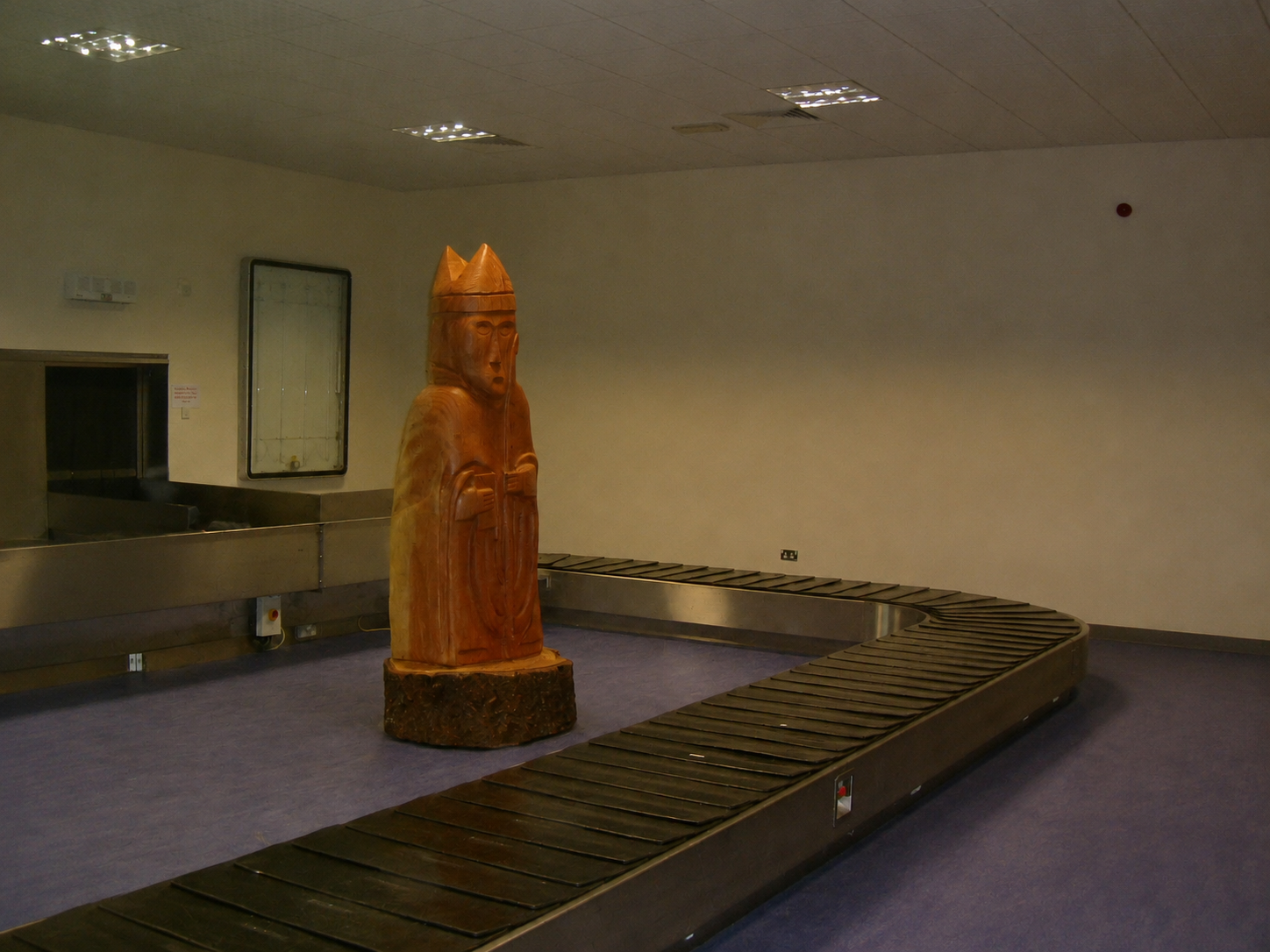
Some day by bag will come …
Ten minutes went by and still no bags. Then, the doors to the runway opened and an older woman staggered in with one of the bags and put it on the static carousel. Then she walked slowly back out to the plane. I offered to go and help but was told that I wasn’t allowed ‘air side’. Three trips back and forth to the plane later my suitcase eventually arrived and I wheeled it into the empty ticket hall to see if I could get a taxi to my hotel. ‘Not on a Sunday’, said the lady behind the sales desk. I asked if I could walk to the hotel but was told it was a fair distance away along an unlit road that crossed the moors. At this point her colleague chipped in to say that she knew someone who might help because ‘he’s an Englishman’. She made a phone call and the Englishman agreed to come and pick me up once his dinner had gone down.
I eventually got to my hotel and it was comfortable and the staff were lovely so I couldn’t be grumpy. Even the taxi driver was a pleasant chap, if mildly bilious. And the next day I had a very successful meeting with some very helpful and professional people and my work was completed with no problems whatsoever. And it was while I was packing away my laptop that one of the councillors asked if I was enjoying my stay. I said that I hadn’t really had a chance to explore and that it was a shame I’d come so late in the year as I would have loved to have visited the ancient stone complex at Calanais.
‘I’ll take you out there later if you like,’ he said. ‘And there’s a near full moon tonight. It will look even better than in the day time.’
He wasn’t wrong. He picked me up in his Land Rover at 7pm and as we approached the area, I could see the tall stones jutting dramatically out of the landscape like the ribs of some long dead giant. It looked amazing. The big moon made it seem almost as bright as day but it was an eerie pallid light that cast long black shadows, stark but beautiful.
And it was at this moment that I suddenly thought, ‘Hang on. I’m a policeman from the mainland who has travelled out to a Scottish island and it’s bonfire season ...’[1]
Calanais – or Callanish as it used to be spelled – is spectacular. From the air it looks like a large cross with a circle at its centre - a bit like a Celtic cross or the Wheel of the Year. The circle consists of 13 tall stones set around a central monolith and burial chamber. Each of the four arms of the cross consists of an avenue lined on both sides with standing stones. The longest and most complete of these, which runs towards the circle from north-north-east, has nine stones along one side and 10 along the other. However, it’s obvious from the gaps and the irregular spacing that many are missing. The other three arms are also missing many of their stones. There are several other smaller circles and a host of standing stones nearby, all erected around 5,000 years ago. Around 50 stones remain standing at the Calanais site – there were undoubtedly many more originally. And, at nearby Loch Roag, there are remains of a wooden henge that may have been built 1000 years before the stones were erected. It has obviously been a place of huge significance for millennia.
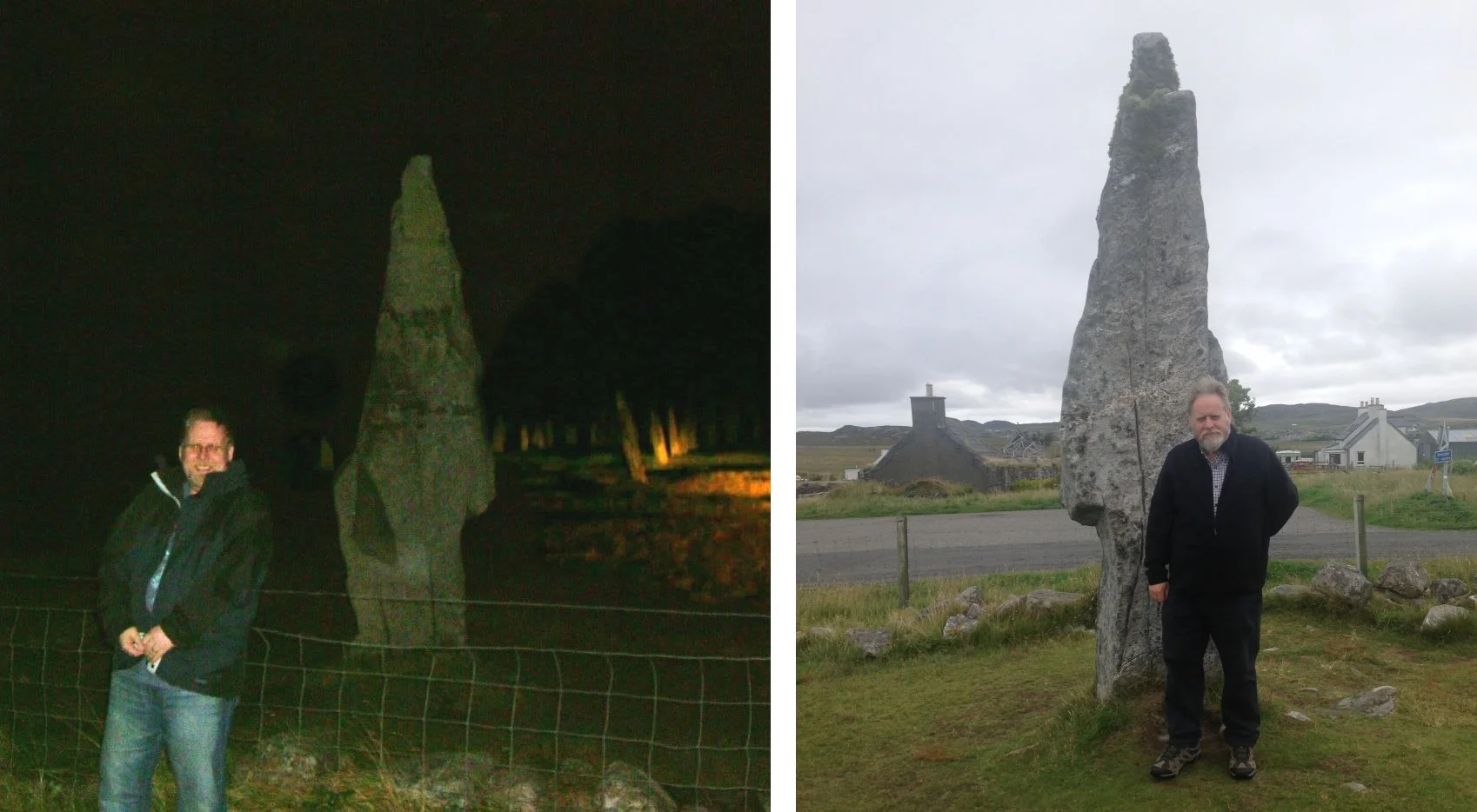
Me on two sides of the same stone, twelve years apart
I’m not a very spiritual person and I’m not often given to flights of fancy but I can’t deny that this place felt special. Maybe it was the fact that it was by moonlight. Maybe it’s because we were the only people there. Whatever the reason, it was an extraordinary thing to experience and it took me right back to those childhood walks in Cornwall where I’d first marvelled at the huge stones that my ancestors had set up in the landscape.
I visited Calanais again in the summer of 2018. The atmosphere was very different this time because it was bright and warm(ish) and there were lots of other people there roaming around, taking selfies and hugging the stones. Watching the crowds made me wonder why we are drawn to these ancient sites. What is it that resonates with us so strongly? Maybe it’s the fact that they represent deep time. In his 2019 BBC documentary How Art Began, sculptor Sir Anthony Gormley suggests that our urge to visit or make physical contact with these ancient stones is one way in which we deal with the knowledge of our own mortality. The rocks don't change in the scale of human life but they do provide a constant reminder that things persist. He urges people to touch the rocks and be connected to eternity.
And, almost instinctively, we do.
[1] If you haven’t got the reference, check out the plot of the iconic 1973 movie The Wicker Man.
.