Once upon a time I discovered, to misquote Orwell, that some animals are bigger b*st*rds than others.
For example, have you ever listened to the lyrics of the Disney song The Ugly Duckling? There’s this cygnet who believes he’s a duckling. And because he looks a little different to his siblings and peers, the other birds verbally (quackily?) abuse him and banish him from his home.
‘There once was an ugly duckling with feathers all stubby and brown
And the other birds in so many words said, ‘Quack! Get out of town!
Quack! Get out! Quack! Quack! Get out! Quack! Quack! Get out of town!’
And he went with a quack and a waddle and a quack in a flurry of eiderdown.
That poor little ugly duckling went wandering far and near
But at every place they said to his face, ‘Now – Quack! get out of here!
Quack! Get out! Quack! Quack! Get out! Quack! Quack! Get out of here!’
And he went with a quack and a waddle and a quack and a very unhappy tear.’
Things are even more graphic in the original Hans Christian Andersen story that inspired the song:
‘The poor duckling was driven about by every one; even his brothers and sisters were unkind to him, and would say, “Ah, you ugly creature, I wish the cat would get you,” and his mother said she wished he had never been born. The ducks pecked him, the chickens beat him, and the girl who fed the poultry kicked him with her feet. So at last he ran away, frightening the little birds in the hedge as he flew over the palings.’
And all because he was different. I’ll bet you’ll look at ducks in a whole new light now won’t you? Maybe they deserve to be rendered and put into pancakes with plum sauce.
Of course, the story has a happy ending in that the duckling discovers that he is actually a swan. But what sort of message is that for kids? It’s okay to be different and to put up with the bullying and teasing because one day, almost magically, you might get handsome or pretty? Does that mean that being pretty is more important than being yourself? It would have been much better if the ‘duckling’ had remained ‘differently ducked’ but had gone on to become an award-winning actor, or had cured duck cancer or done something equally brilliant to prove that looks aren’t everything. That’s a moral I can get behind. Maybe we should change the name of the story from ‘The Ugly Duckling’ to ‘The perfectly normal cygnet who was abused by a bunch of arrogant judgemental ducks’.
And what about the racism inherent in bull society? As Tommy Steele explained in song:
‘Once upon a time there was a little white bull
Very sad, because he was a little white bull
All the black bulls called him a coward
Just ’cause he was white
Only black bulls go to the bullring,
Only black bulls fight.’
Not content with teasing him because of the colour of his skin, his bullish bullies actually force the little white bull to prove that he’s as good as ‘bulls of colour’. Consequently he charges at a matador who proclaims him to be brave enough – possibly even ‘the best in Spain’ – to fight in the arena. Consequently, he can now die a horrible, slow, cruel death for the jeering bloodthirsty crowds when he could have avoided all that and become a great writer or artist and a recipient of the Nobull Peace Prize (sorry).
And don’t get me started on Rudolf the Red-Nosed Reindeer.
It’s interesting isn’t it? We sing these songs to our kids and our grandkids and we don’t generally bother to analyse the lyrics. Mind you, I was sung those songs as a child and it’s only relatively recently that I’ve thought about what the Hell I was actually listening to. In the grand scheme of things, they’re probably pretty harmless. But it is extraordinary just how many nursery rhymes, faerie stories and children’s songs you can find that have really quite grim undertones or mixed messages when you’re forced to look at them in detail.
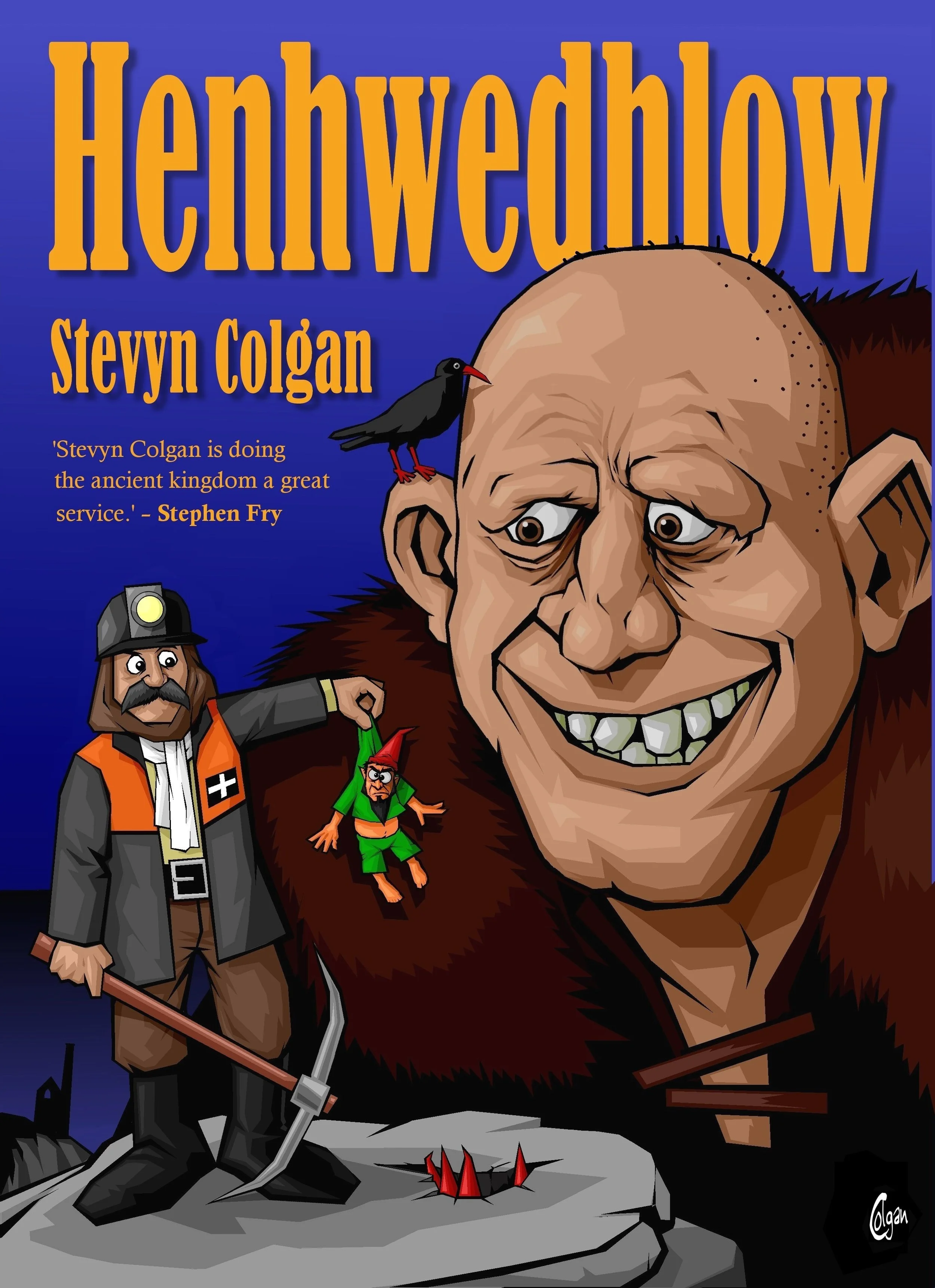
It’s pronounced ‘Hen-weth-low’. Illustration by me.
A couple of decades ago I was asked by the Cornish Language Council (Kowethas an Yeth Kernewek) to update a bunch of Cornish folk tales and Faerie stories for modern child readers. The result was Henhwedhlow: The Clotted Cream of Cornish Folktales, published by Kowethas in both English and Cornish (with translation by the great Cornish Bard, Tony Hak). I loved the idea of dragging a bunch of Cornish stories out of the literary storage jars in which they’d been pickled for centuries and updating them for the 21st century. But that meant looking closely at the messages hidden within them.
You see, in Europe, people like the Brothers Grimm and Hans Christian Andersen collected hundreds of folk tales, myths and legends and re-wrote them for a younger audience. They turned stories that were often cruel, amoral or wouldn’t appeal to the sensibilities of the day into contemporary children’s stories. However, times were different in their day, so the resulting stories were still a bit grim. And, as time as gone on, the stories have continued to evolve to suit the times in which they are told. If you compare Disney’s The Little Mermaid with Andersen’s original tale, for example, it’s very different.
But we didn’t have any Grimms or Andersens here in the UK (with the notable exception of Joseph Jacobs). Instead, our stories were collected and archived in academic tomes by 18th century folklorists, which left them as dry and dusty as pinned moths in a display case. Academics aren’t generally storytellers and their collections were intended for adults to study rather than for children to read at bedtime. Which is why Cornish kids know more about Hansel and Grethel than they do about Jan the Mounster or Wicked Tregeagle. Pick up any book of Cornish faerie stories and you’ll find that most simply re-hash the work of folklorists Robert Hunt and William Botterell and some even reprint their works word for word. It’s almost as if people are scared to change them.
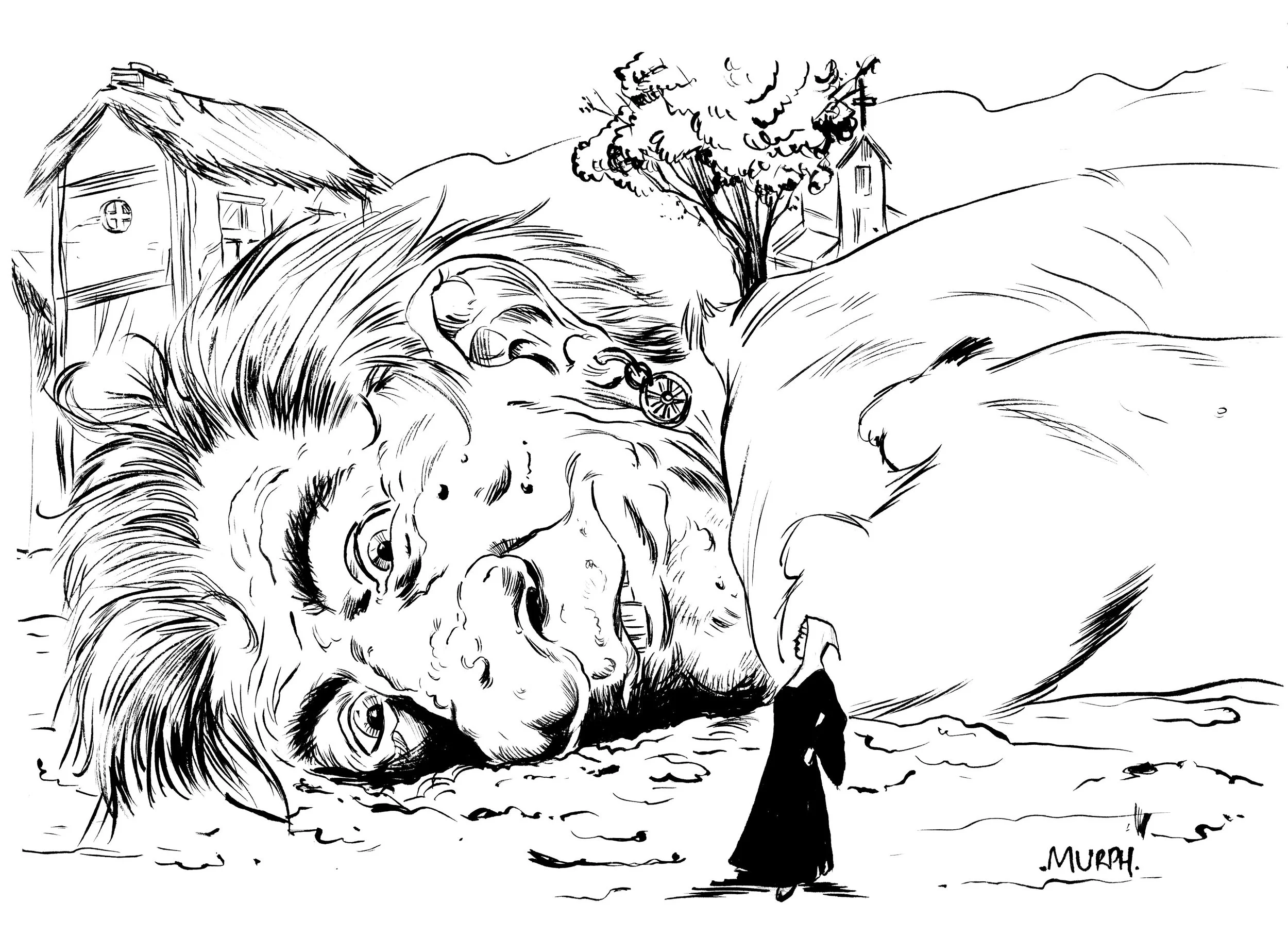
Bolster theGiant and St Agnes. Illustration by James Murphy for Henhwedhlow.
I grew up in Cornwall and I was lucky because I was told these stories by my dad. He loved his county and was keen to preserve its traditional stories. Most of my school friends didn’t have that advantage and never learned them. And, when I got older, I wanted to pass those stories onto my kids. But no one, it seemed to me, had ever made an effort to re-write and retell these stories for children as Andersen and the Grimms had done. And that bothered me because, if we don’t make these stories relevant to children today, they’ll remain the property of academics and our kids will lose sight of them forever.
So that’s what I did. I updated 12 Cornish stories for 21st century sensibilities. And it was tough. I had to totally re-write the endings to some stories while keeping a sense of the original. I had to introduce a moral to most of them as the original tales were often pointlessly cruel or nasty. And I had to constantly watch for those embedded themes that might send the wrong signals to kids.
I came to call them ‘duck and bull stories’.
Take the story of Bolster the Giant. In the original tale, he mopes about after St Agnes who he’s fallen hopelessly in love with. She gets fed up with this and, in a very un-saintly hissy fit, tricks him into slashing his wrists and bleeding to death. What a lovely story, eh? My solution was to firstly remove any religious overtones so St Agnes became ‘Bloody’ Bitha, a wanted criminal on the run who disguises herself as a nun – Sister Agnes – and hides out in a convent. However, she hasn’t reckoned on a lovelorn Bolster who follows her about attracting unwanted attention and threatening to blow her cover. In a final scene, she tricks him into nearly killing himself but, in the nick of time, a faulty love potion exhibits some weird side effects and Bolster is saved. Nasty Sister Agnes is, of course, thwarted and locked up in Bodmin gaol. I managed to keep 99% of the elements of the original story while also telling a tale of good triumphing over evil (there’s also a cautionary tale in there about drugs too). And because I wrote it in a modern Roald Dahl kind of style, there were plenty of fart gags in there too.
As I said earlier, I don’t think that the majority of songs, faerie tales and kids’ stories necessarily have a huge impact on a child’s development. Ridiculous gender-based toys do far more damage, for example. But if hidden messages affect even a few kids and make their lives a little less happy and a little less fulfilled than they might have been then it’s something we need to watch for as writers and storytellers. It bothers me hugely that every Disney princess is impossibly slim and beautiful; have you seen their waists? A wasp would need a bigger belt. That’s a duck and bull issue as far as I’m concerned because it’s constant, repetitive reinforcement of an unachievable target for most young girls. At least not without a lifetime of neuroses and dieting and possibly surgery.
Beauty is relative; it’s entirely subjective and ‘different’ does not mean the same thing as ugly. It’s why I’d always push my grandkids towards watching a movie like Shrek rather than Sleeping Beauty. Fiona comes to realise that beauty really is just skin deep and Shrek sees beyond the surface and falls in love with the person. And on that subject, let’s not forget the boys here. Wouldn’t it be a positive thing for my grandson to see a story like Beauty and the Beast or The Hunchback of Notre Dame where it’s the female character who’s ‘different’ rather than the male? Where the male lead falls for the female lead because she’s freakin’ awesome rather than just pretty?
There’s something for Disney to think about. And for all of us who write stories to think about.